Official Website Authority
Does your hotel website clearly explain who you are, where you are, what you offer, and why travelers should choose your property?
Use this free checklist to review whether your hotel website has the visibility signals AI travel tools may need to understand, trust, and recommend your property.
The checklist focuses on official website clarity, direct booking exposure, local demand relevance, review and trust signals, OTA dependence risk, and AI-readable hotel content.
This checklist is a readiness resource. It does not run live AI searches or guarantee AI recommendations.
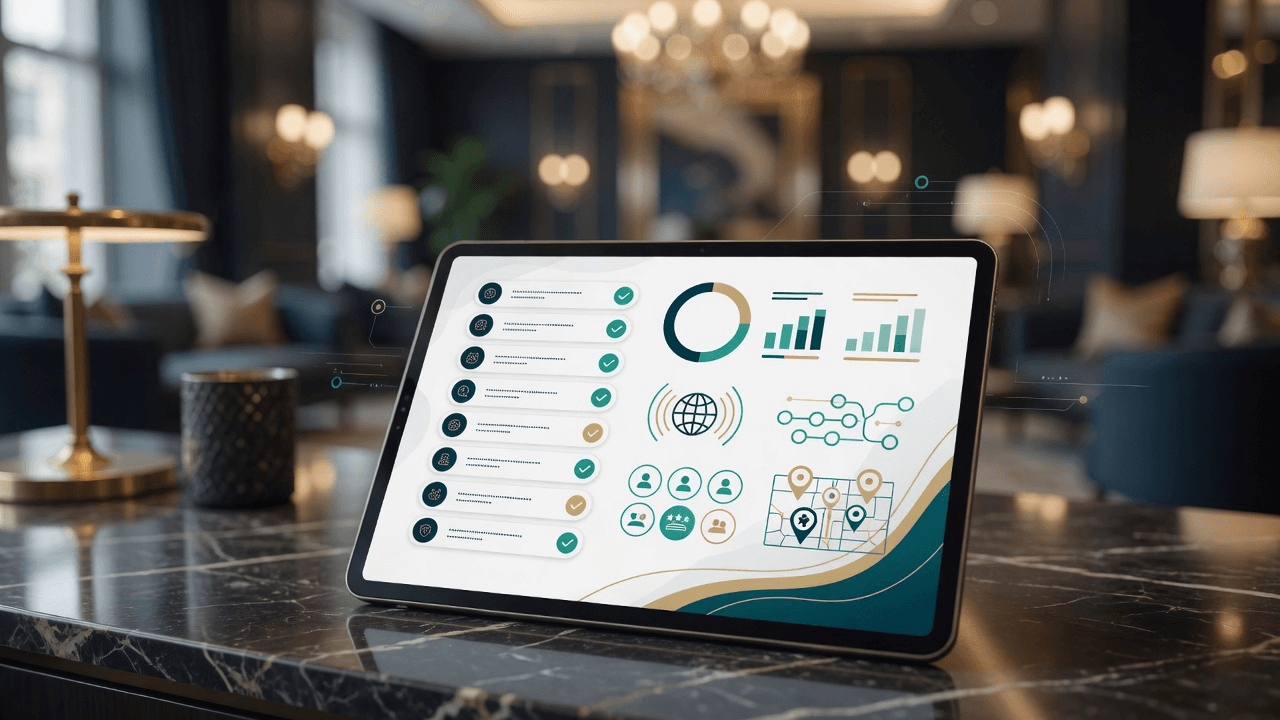
When a traveler asks an AI assistant where to stay, the answer may be shaped by your official hotel website, OTAs, review platforms, directories, destination content, and competitor pages. If your official website is thin, unclear, outdated, or missing key travel signals, AI tools may rely on third-party sources instead.
That creates direct booking risk. Your hotel may still be mentioned, but the path to the guest could be controlled by an OTA, review site, directory, or competitor narrative.
Does your hotel website clearly explain who you are, where you are, what you offer, and why travelers should choose your property?
Can travelers easily book direct, contact the hotel, request group information, or take the next step without being pushed back to third-party platforms?
Does your site connect the hotel to nearby companies, hospitals, universities, venues, attractions, event centers, sports complexes, and neighborhoods?
Does your official website reinforce guest confidence through reviews, testimonials, awards, reputation themes, photos, policies, and proof points?
Does your website include clear pages, FAQs, structured descriptions, room/service details, meeting information, and local content that AI tools can interpret?
Would OTAs, review platforms, directories, or competing hotels provide a clearer answer than your official website?
The checklist includes 25 practical visibility signals across the areas that matter most for hotels preparing for AI-assisted travel discovery.
Download the full checklist to review all 25 signals.
Use the checklist to identify thin content, weak booking paths, and missing trust signals on the official hotel website.
Use the free rules-based scan to turn the checklist into a simple readiness preview and risk conversation.
If risk is visible, request a full AI Visibility Report for competitor, OTA, local content, and direct booking review.
Use these comparison guides to understand why the checklist focuses on official website clarity, OTA exposure, direct booking paths, and trust signals.
AI Search
Travelers are beginning to use AI assistants for recommendations, comparisons, itineraries, and booking research. Hotels need to understand how AI answers differ from traditional search results.
Read report
OTA Risk
The risk is not only whether AI tools mention your hotel. The bigger question is which source controls the answer and where the traveler is sent next.
Read report
AI Search
Hotels cannot force AI assistants to recommend them, but they can improve the visibility signals that help AI tools understand when the property is relevant.
Read report
Sample Index Report
A market snapshot of hotel visibility readiness, OTA exposure, direct booking risk, and local demand signals in Orlando.
Read latest Index
Review Pool
Be considered for future market reviews, readiness examples, or AI Travel Visibility Index topics.
Submit your hotel
SalesHospitality can help turn checklist findings into practical next steps for visibility, direct booking, local demand, trust, and revenue capture.